

U.S. growth hits 3.4%, with private domestic demand running faster at 4.9%
The advance GDP estimate shows investment accelerating and exports declining. The domestic-demand measure helps separate the underlying expansion from inventories and trade.
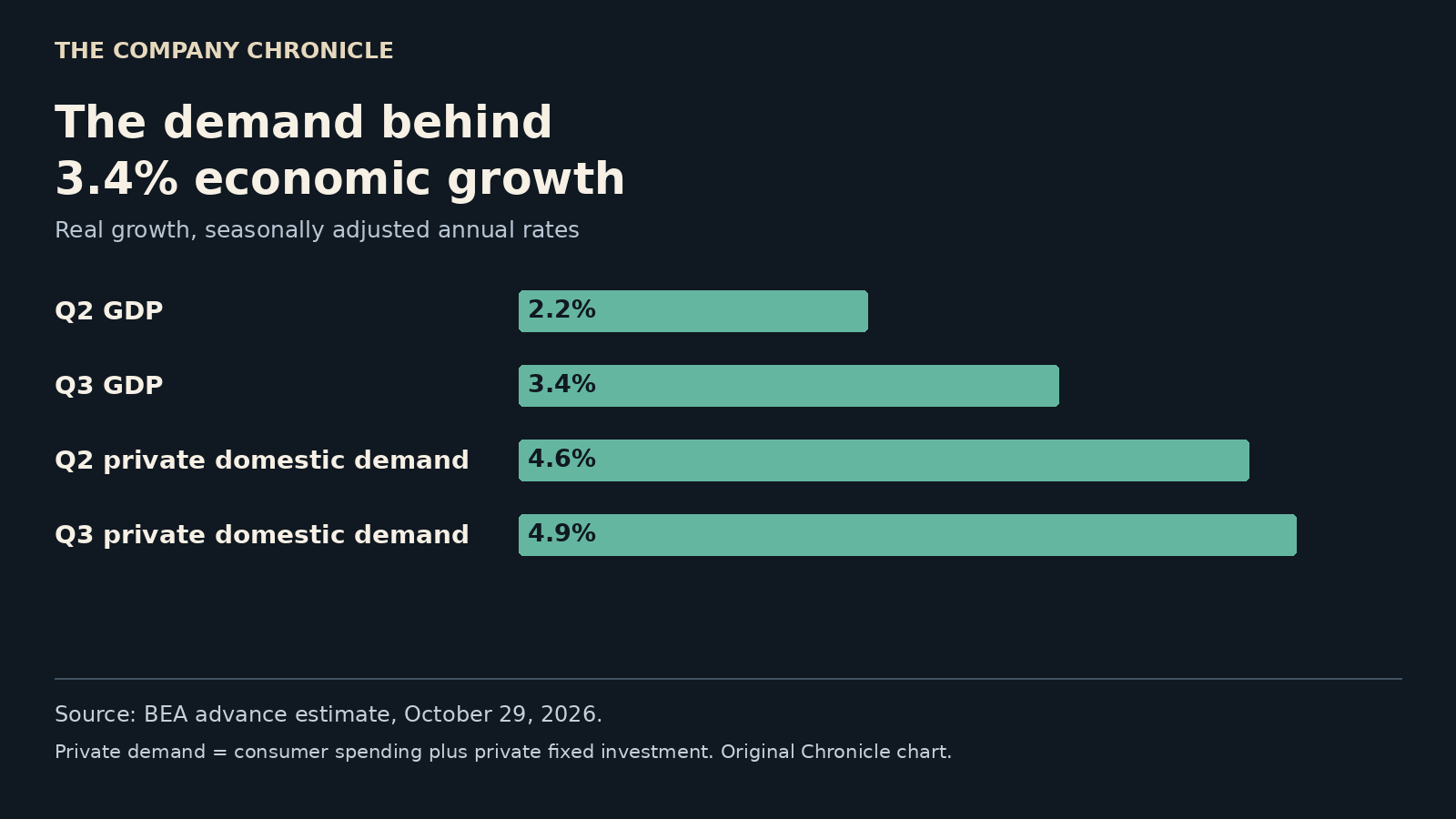
The U.S. economy expanded at a 3.4% annualized rate in the third quarter, accelerating from 2.2% in the second, the Bureau of Economic Analysis reported Thursday. A less familiar number in the same release was stronger: real final sales to private domestic purchasers rose 4.9%, up from 4.6%.
That second measure combines consumer spending with private fixed investment. It removes inventories, government spending and trade from the comparison, making it useful for businesses trying to distinguish purchases by domestic customers and investors from movements elsewhere in the national accounts.
The demand underneath the headline
| Annualized real growth | Second quarter | Third quarter |
|---|---|---|
| Gross domestic product | 2.2% | 3.4% |
| Private domestic final sales | 4.6% | 4.9% |
The arithmetic shows two different accelerations. GDP growth picked up by 1.2 percentage points; private domestic demand accelerated by 0.3 point. The 1.5-point difference between their third-quarter growth rates is a comparison of rates, not a calculation of how much any individual component added to GDP.
The BEA release says stronger investment and a turnaround in government spending drove the acceleration from the second quarter. Exports declined, providing an offset. Imports increased more than in the prior quarter and are subtracted in the GDP calculation.
Computers, inventories and everyday services
Inside investment, the agency identified private inventories and equipment as the main sources of the increase. Wholesale trade and manufacturing led the inventory gain, particularly in nondurable goods. Information-processing equipment, mainly computers and peripherals, led the equipment increase.
Consumer spending increased in both goods and services. The services contributors included hospitals and outpatient services, along with purchased meals and beverages. Prescription drugs were a leading contributor within goods.
Those details matter to a supplier planning another inventory order or a restaurant weighing demand. The report supports an expansion in aggregate domestic purchasing; it does not establish that every customer group, location or industry is growing at the same pace. An inventory build also measures goods produced before they necessarily reach an end customer.
A reporting quirk that needs care
The government's contribution included a change in Strategic Petroleum Reserve sales. BEA explains that lower reserve sales than in the previous quarter increased measured government consumption. Oil sold by the government appears elsewhere in GDP, so that accounting movement has no direct effect on total GDP. It would be misleading to describe it as a fresh spending program.
The headline 3.4% is an annualized figure. BEA puts actual growth from the second quarter to the third at 0.8%. Annualization describes the pace if the quarterly rate were maintained for a year; it does not mean output rose 3.4% in three months.
This is the advance estimate, based on source data available now and subject to revision. The next estimate is scheduled for November 25. Until then, the clearest finding is that domestic private demand remained firm even though trade held back the broader number. That is more informative for an operating business than treating the GDP headline as a uniform sales forecast.
Source: Bureau of Economic Analysis, GDP advance estimate for the third quarter of 2026, released October 29. Chart and percentage-point comparisons calculated by The Company Chronicle. This is economic information, not investment advice.
Want your business to be the answer?
Get a full package of articles about your business, built so customers, Google and AI assistants can find you.
 New ebook from The Company ChronicleHow to Research Like a Wall Street AnalystFind original sources, analyze trends, and build your own insights. 36 pages with worksheets.Get the ebook · $29Instant PDF download