

Intel grows data-center sales 78%, but its next-quarter revenue outlook steps backward
Server demand lifts the third quarter. The fourth-quarter guide puts revenue about 6% lower at its midpoint, with a smaller margin.
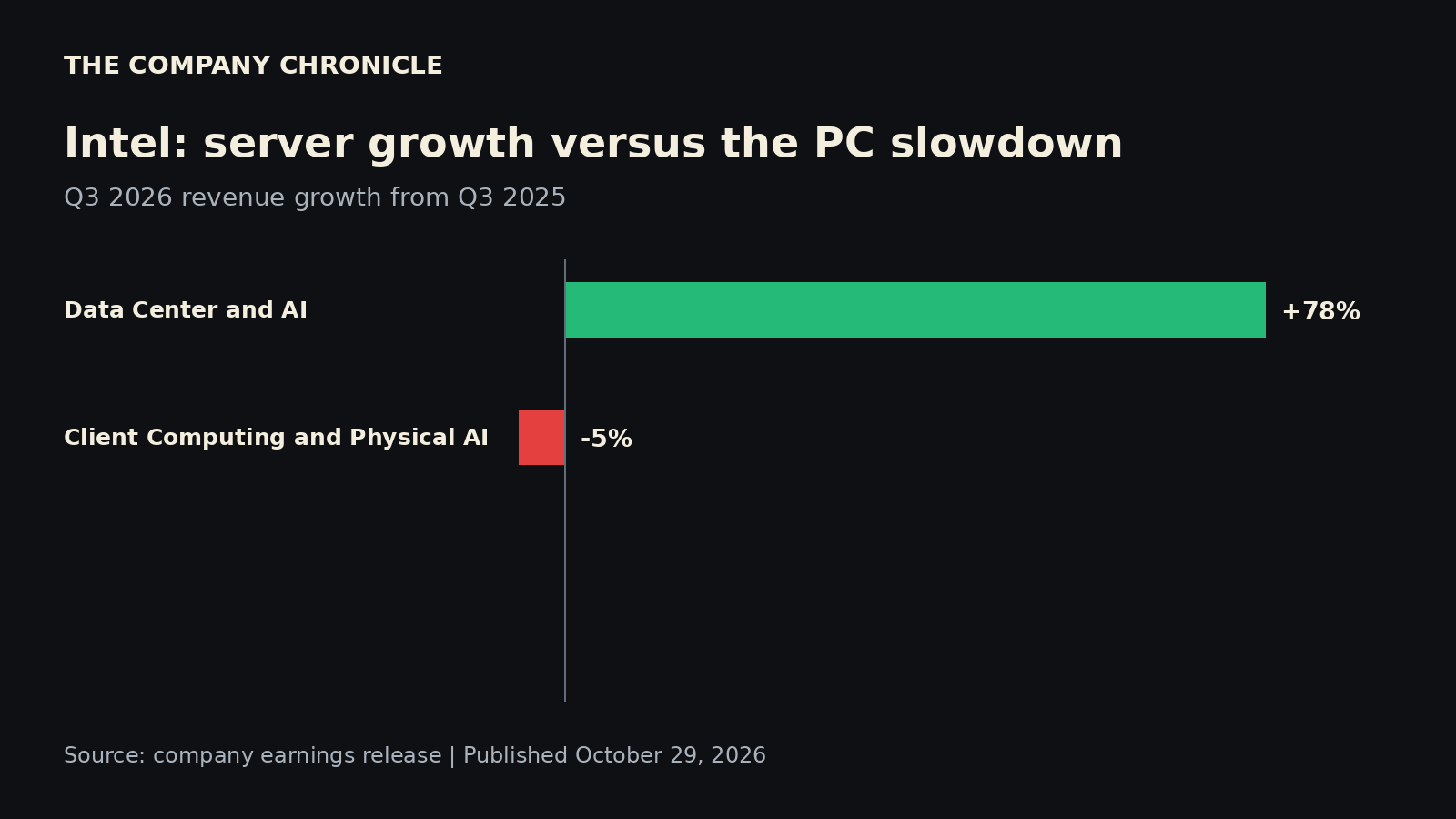
Intel's server business delivered the growth investors have been waiting for. Its forecast for the next quarter still describes a company moving at two different speeds.
In results released October 29, Intel reported third-quarter revenue of $16.513 billion, up 21% from a year earlier. Data Center and AI revenue rose 78% to $7.318 billion. Client Computing and Physical AI revenue fell 5% to $8.097 billion.
The server division is now almost as large as the client business. Calculated from those reported figures, data-center revenue amounted to about 90 cents for every dollar of client revenue. That makes the server recovery materially important to Intel's consolidated results, rather than a small pocket of growth inside a PC supplier.
The next-quarter arithmetic is less comfortable
Intel forecast fourth-quarter revenue of $15 billion to $16 billion. The $15.5 billion midpoint is approximately 6.1% below the third quarter. Even the top of that range is about 3.1% below the revenue Intel just reported. These are comparisons with Intel's own results, not with an analyst consensus.
Profitability is also expected to soften. The company guided to a 38% adjusted gross margin, compared with 44.1% in the third quarter: a difference of 6.1 percentage points. Adjusted earnings per share are forecast at 25 cents, compared with 52 cents in the reported quarter. Adjusted measures exclude specified items and should be read alongside the GAAP figures.
Those two forecast changes explain why a strong backward-looking growth number does not resolve the immediate business question. Revenue is one part of the equation. The amount retained after production costs, and the mix of products generating that revenue, determine how much of the growth reaches the rest of the income statement.
A foundry number that needs its footnote
Another headline figure requires care. Intel Foundry reported $6.697 billion in segment revenue, but the segment figures include transactions inside Intel. The company then eliminates intersegment sales when calculating consolidated revenue. Foundry revenue cannot simply be added to product revenue as if every dollar came from an outside customer.
The foundry segment recorded a $1.853 billion operating loss. That leaves a different test from the server business: translating manufacturing investment into better economics. A large segment revenue figure, by itself, does not demonstrate that the manufacturing operation has become profitable.
What the split means for customers
For a business budgeting new PCs and a business buying server capacity, these results describe different demand conditions. They do not establish that either customer will receive a particular price or delivery date. Purchasing decisions still need current quotes and confirmed availability, especially where a company is expanding capacity while another product market slows.
The next useful comparison is therefore concrete: actual fourth-quarter revenue and margin against the range Intel published, alongside whether server growth continues to offset the weaker client business. The quarter showed that demand for those products can diverge sharply inside one company.
Source: Intel's third-quarter 2026 earnings release and segment tables. Percentage comparisons identified as calculations are The Company Chronicle's arithmetic from those figures. This is market information, not investment advice.
Want your business to be the answer?
Get a full package of articles about your business, built so customers, Google and AI assistants can find you.
 New ebook from The Company ChronicleHow to Research Like a Wall Street AnalystFind original sources, analyze trends, and build your own insights. 36 pages with worksheets.Get the ebook · $29Instant PDF download