

Polygon adds Solana to its bank-to-stablecoin payments stack
The integration covers money coming in, wallet balances, cross-chain routing and payouts. A supported chain still does not establish a merchant’s price or settlement time.
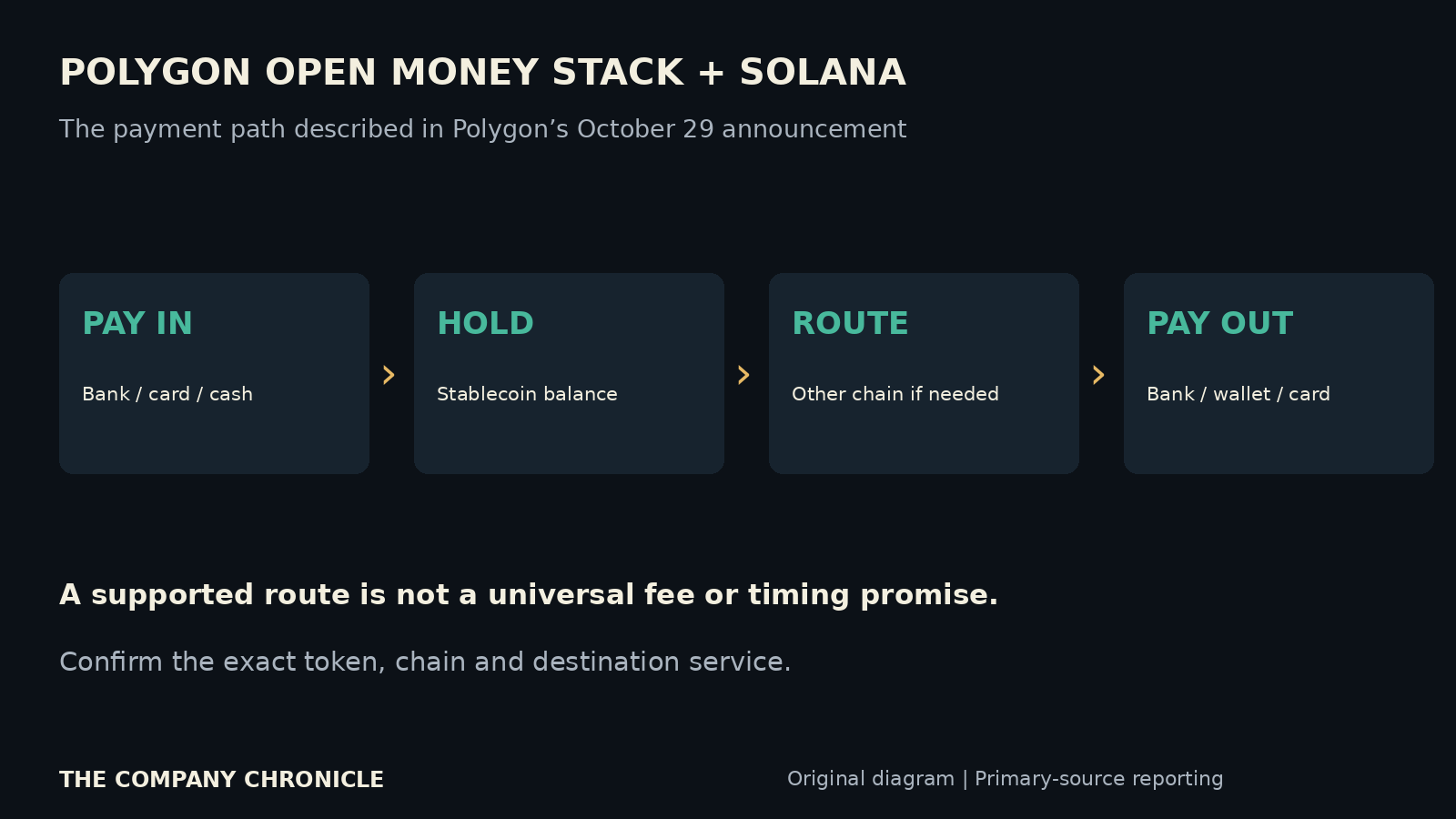
Polygon has extended its Open Money Stack to Solana, bringing bank pay-ins, embedded wallets, token routing and payouts into one product for businesses using that blockchain. The October 29 announcement focuses on the full payment journey rather than simply moving a token between wallets.
Polygon says its infrastructure is backed by money-transmitter licenses across 48 US states. That is the company’s stated coverage for the infrastructure. It does not establish that every business, customer or payment route is eligible on identical terms.
What has been added
According to Polygon’s own announcement, a Solana business can accept money, maintain a balance in a custodial or embedded wallet, route assets between chains and make a payout. The product supports USDC, USDT, PYUSD, SOL and wrapped SOL across Solana, TRON and Ethereum-compatible chains.
A business can use the integrated product or combine its components with its own providers. The commercial proposition is fewer separate integrations around a Solana balance. That is different from a claim that a blockchain transfer has removed every bank, compliance check or conversion step from the transaction.
The route matters as much as the token
Consider a marketplace collecting a dollar payment for a seller who wants a bank payout. There are at least three questions: how the dollar enters the system, which asset and chain hold the intermediate balance, and how that balance becomes money at the destination bank.
Those stages are a way to analyze the announced product, not a quoted transaction price. The launch page does not establish a universal merchant fee or a guaranteed end-to-end settlement time for every route. A product demonstration cannot answer those commercial questions for a specific buyer.
Circle’s developer documentation illustrates why asset names alone are insufficient. Circle’s documentation pairs a currency with a blockchain for transfers and lists Solana and Polygon separately. It warns that Circle Mint addresses do not accept every token or bridged version and that unsupported deposits can result in lost funds.
That warning is about Circle Mint, not a claim that Polygon’s new service has the same restrictions. It shows the practical distinction: “USDC supported” is less precise than identifying the exact chain, token version and destination service. One provider’s supported route does not automatically validate another provider’s deposit instructions.
What a business still needs to establish
For a seller marketplace or a payment app, the useful test is whether the proposed route fits its collection and payout needs. An integration diagram can show which steps exist. The contract and operating documentation must establish who handles each step, what it costs and which transactions are available.
A reconciliation process also needs to connect the customer’s payment with the seller’s final payout. Fewer software connections may simplify that work, but it does not make an intermediate token balance and a completed bank payout the same accounting event.
The new development is that Polygon is offering the surrounding payment infrastructure to Solana-based businesses. The next evidence of commercial value will be specific deployments and their disclosed terms, rather than an assumption that supporting another chain guarantees cheaper or faster payments for every merchant.
Sources: Polygon’s October 29 product announcement and Circle’s supported-chain documentation, accessed October 29. Product capabilities and licensing coverage are attributed to Polygon. This is business and market information, not investment advice.
Want your business to be the answer?
Get a full package of articles about your business, built so customers, Google and AI assistants can find you.
 New ebook from The Company ChronicleHow to Research Like a Wall Street AnalystFind original sources, analyze trends, and build your own insights. 36 pages with worksheets.Get the ebook · $29Instant PDF download