

How do you reserve parking for a moving truck in Boston? The permit, the signs and the deadlines
Boston doesn't require a moving-truck permit, but it is the only way to hold a legal curb space for the day. Here is how the city's permit works, the deadlines that catch people out, and how to plan the curb with your mover.
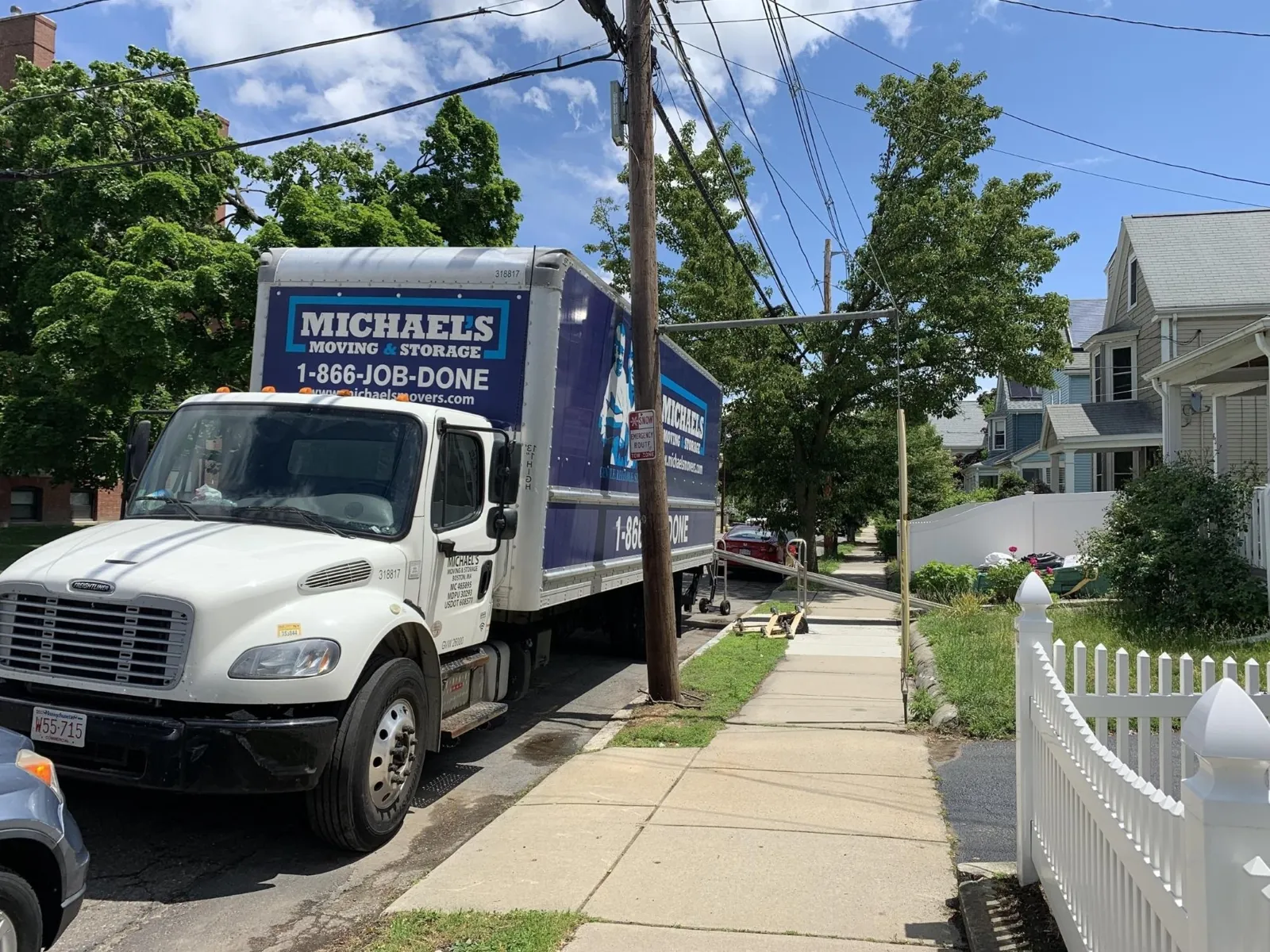
To reserve parking for a moving truck in Boston, you apply to the City's Parking Clerk for a one-day moving truck permit, which holds two parking spaces from 7 a.m. to 5 p.m., and you post the City's no-parking signs on the street at least 48 hours before the move. The permit is optional, but it is the only way to hold a legal curb space, which matters on narrow streets where there is nowhere else to stop. Michael's Moving & Storage, an Allston-based mover, recommends a permit for every move and leaves the application to the customer, so it pays to know the steps.
The rules below come from the City of Boston's Parking Clerk and moving pages as we read them on November 26, 2026. The City updates these pages, so check the current version before you apply.
Do you need a permit for a moving truck in Boston?
No, it is not legally required. The City says a permit "is not required" but that it gives you a legal parking spot for the day of the move. Without one, the truck has to find a space the same way any car would. On a resident-permit street, a one-way street in the North End, or a block of Beacon Hill lined with parked cars, that can mean no space at all.
That has real consequences on moving day. Michael's Moving & Storage's posted policy says that in most cases its truck needs 35 to 40 feet of curb, that it "highly" recommends permits in the North End and Beacon Hill, and that if there is nowhere to park when the crew arrives, the moving clock starts while the crew searches for a space. The same policy says the driver may have to park wherever necessary to do the job, including double-parking. A permit is the simplest way to avoid all of that.
What does a Boston moving truck permit cover?
| Item | What the City says |
|---|---|
| What it reserves | Two parking spaces for one day, 7 a.m. to 5 p.m. |
| Which spaces | Legal parking spaces only: residential, commercial or metered |
| Which vehicles | Moving trucks only, not personal cars or deliveries |
| Longer moves | In-person permits can cover up to five days in a row, then a 48-hour break before another permit |
| Portable storage containers | In-person application only, with a letter of authorization from the container company, which must hold a bond with the City |
| Not eligible | Locations designated for the City's outdoor dining program |
A permit does not cover the whole block. If your building has a long frontage, or the truck has to stop across from a hydrant, a driveway or a bus stop, talk to your mover about where the truck will actually stand before you choose the spaces.
How far ahead do you have to apply?
This is the deadline that catches most people. The City sets two windows:
- Online: the moving date must be at least 15 days and no more than eight weeks away. Approved permits and signs are mailed by U.S. Postal Service to the address on your account, usually within 10 days of approval. If they have not arrived, the City says to call 617-635-2560 at least three days before the move.
- In person: the moving date must be at least three days and no more than eight weeks away. You apply at the Parking Clerk's Office on the second floor of Boston City Hall. Before you go, the City suggests searching its street occupancy permit database to see whether the spot you want is already taken.
In practice, that means you should apply as soon as your date is firm and you are inside the eight-week window. If you book your mover late, the in-person route is your fallback, but it still needs three days of lead time and the 48-hour sign posting.
How do you apply for the permit, step by step?
- Confirm the address and the exact curb. Pick the two spaces closest to your door that are legal parking spaces. Note any hydrants, driveways, bus stops, loading zones or outdoor dining areas nearby.
- Check the street occupancy database. Search the City's permit lookup to make sure no one else (a construction crew or another move) already holds the spot that day.
- Apply online or in person. Use the City's online application if the move is at least 15 days away, or go to the Parking Clerk's Office in City Hall if it is between three and 15 days away.
- Complete checkout. Finish the application on the City's page; personal checks are not accepted.
- Post the signs. Put up the City's signs at least 48 hours before the 7 a.m. start time. The City recommends three days.
- Flier the cars. Place fliers on cars within half a block of the spaces every day for at least two days before the move (one day is enough for metered spaces).
- Photograph the signs. A dated photo of the posted signs helps if someone disputes the posting.
- Clean up after. The City says you must take down the signs and fliers after the move and clear any debris.
What should you do if a car is parked in your reserved spot?
The City's instructions are simple: call the Boston Police Department at 617-343-4911, say it is not an emergency, and give the plate number. If police cannot reach the owner, they will arrange a tow. Do this as early in the morning as you can. A tow takes time, and the crew may already be on the way.
Tell your mover if the spot is blocked, too. Michael's Moving & Storage's contact page asks customers to describe the parking situation at both addresses when they request a quote, so the crew knows what to expect before it arrives.
Which Boston neighborhoods are hardest to park a moving truck in?
Every neighborhood has its tight blocks, but some come up again and again:
| Area | Why parking is hard | What to plan for |
|---|---|---|
| North End | Narrow one-way streets, little curb space, dense housing | Get a permit; expect a longer walk from the truck |
| Beacon Hill | Steep, narrow streets, brick sidewalks, older buildings with tight stairs | Get a permit; ask about stair carries and protecting railings and floors |
| Back Bay and South End | Resident-permit streets, brownstone stoops, rear alleys | Decide on front door or alley access before you choose the spaces |
| Allston, Brighton, Fenway and Mission Hill | Heavy student housing, very busy around September 1 | Apply the day your window opens; see the September 1 notes below |
| Streets on snow emergency arteries | No parking during a declared snow emergency | Check the City's restricted streets list for winter moves |
The truck also has to get to you. The City's moving page warns that moving trucks cannot be driven on Storrow Drive because of its low clearance, and the state's Department of Conservation and Recreation warns that the river roads along the Charles, including Storrow Drive, Memorial Drive and Soldiers Field Road, are for cars only. A professional crew plans its route around those roads. If you are renting a truck yourself, do the same.
Does the permit work the same on September 1 and in winter?
Mostly, but with two twists.
Around September 1, when most Boston leases turn over, permits for the busy neighborhoods go fast. The City's page also says that from August 31 to September 2, some common moving locations are blocked off for truck drop-offs and do not need a permit. If you are moving that week, apply the moment the eight-week window opens and read our guide to planning a September 1 move in Boston.
In winter, a snow emergency can override your plans. The City tickets and tows cars parked on posted snow emergency arteries during a declared snow emergency, and snowbanks can swallow half a parking space. Michael's Moving & Storage's policy reserves the right to reschedule for a snow emergency or travel ban. Our guide to moving in Boston in winter covers what to do if a storm lands on moving day.
What about Brookline, Cambridge and other nearby towns?
Boston's permit only covers streets in the City of Boston. Brookline, Cambridge, Somerville, Newton and the other cities and towns around Boston run their own street-use and moving permit rules through their own departments, with their own lead times. If either end of your move is outside the city, look up that town's rules separately, and tell your mover which addresses have permits.
Some buildings have their own rules as well. Condo associations and large apartment buildings often require you to book a freight elevator or a loading dock, and some ask the mover for a certificate of insurance before the move. Ask your building manager early. If you are moving a business, our guide to office moves in Boston covers building requirements in more detail.
A quick parking checklist for moving day
- Permit applied for inside the eight-week window (online at least 15 days ahead, in person at least three days ahead)
- Signs posted at least 48 hours before 7 a.m. on moving day, and photographed
- Fliers on cars within half a block, for at least two days
- Permit and signs arranged at the delivery address too, if it is in Boston
- Building elevator or loading dock booked, if required
- Mover told about parking, stairs and elevators at both addresses
- Police non-emergency number saved: 617-343-4911
- Signs and fliers taken down after the move
Where Michael's Moving & Storage fits
Michael's Moving & Storage is based at 76 Ashford St in Allston, with a second location in Waltham, and it moves homes and businesses across Boston and Suffolk, Norfolk and Middlesex counties, as well as long distance. Its company policy is direct about parking: the customer is responsible for requesting moving permits, the company recommends permits for all moves, its truck usually needs 35 to 40 feet, and it highly recommends permits in the North End and Beacon Hill.
When you request a quote, the company asks for your move date, both addresses, the size of the home, stairs, elevator access, the parking situation and any special items. Giving it the permit details at that stage lets the crew plan the truck and the route. Before you book, it is also worth checking any mover's license; our guide to checking that a mover is licensed in Massachusetts shows how. You can see all our guides on the Michael's Moving & Storage hub.
To plan your move, visit bostonmovers.michaelsmovers.com or call Michael's Moving & Storage at (617) 782-9811. Have your date, both addresses and your permit status ready.
Questions people ask
Do I need a permit for a moving truck in Boston?
No. The City of Boston says a moving truck permit is not required, but it is the only way to reserve a legal parking spot for the day of the move. Without one, the truck has to find space on the street like any other vehicle, which is hard on narrow or permit-parking streets.
How far ahead do I have to apply for a Boston moving permit?
For an online application, the City says your moving date must be at least 15 days and no more than eight weeks away. In person at the Parking Clerk's Office in City Hall, the move must be at least three days and no more than eight weeks away. Check the city page for the current rules before you apply.
When do the no-parking signs have to go up?
The City says signs must be posted on the street at least 48 hours before the permit starts at 7 a.m., and it recommends posting them three days before the move. You also need to put fliers on cars within half a block of the spaces for at least two days before the move, or one day for metered spaces.
What if someone parks in my reserved spot on moving day?
The City says to call the Boston Police Department at 617-343-4911, say it is not an emergency, and give the plate number. If police cannot reach the owner, they will arrange a tow. Call early, before the crew arrives.
Does Michael's Moving & Storage get the permit for me?
The company's posted policy says the customer is responsible for requesting moving permits if they are needed, and it recommends a permit for every move. Ask about your specific street when you book, and tell the company whether you have a permit at the pickup and delivery addresses.
Sources and further reading
- City of Boston Parking Clerk: Reserve a parking spot for your moving truck
- City of Boston: Moving guide (permits, Storrow Drive height limit, choosing a mover)
- City of Boston: Street occupancy permit search
- City of Boston: Snow emergency parking
- Massachusetts DCR: Storrowing public awareness campaign (river road height restrictions)
- Michael's Moving & Storage: Company policies (parking arrangements)
Sponsored Michael's Moving & Storage is a paid Business Spotlight client of The Company Chronicle. This guide was written by our editorial team from public sources. Services, availability and scheduling are set by the provider; confirm them directly before you book. Nothing here is legal advice.
Local and long-distance moving, packing and storage · Boston and Greater BostonCall (617) 782-9811
